
By 2026, retail will no longer be a game of gut-instinct—it will be a game of intelligence. As customer expectations rise and competition intensifies, retailers are discovering a hard truth: standing still is the fastest way to fall behind. Industry leaders are already moving beyond dashboards and reports toward AI-driven operating models that sense, decide, and act in real time.
Look at today’s market leaders. Their advantage doesn’t come from scale alone—it comes from how effectively they convert data into decisions. Every click, store visit, basket change, and supply chain signal becomes a measurable input for action. But raw data is not enough. The winners are those who can orchestrate analytics across functions, revolutionizing fragmented metrics into prescriptive and predictive insights.
In this blog, we’ll explore some high-impact retail data analytics use cases that retailers should priorotize on in 2026. Let’s explore.
Top retail data analytics use cases that retailers should look at
#1 Inventory management
In the current scenario, poor demand forecasting creates a ripple effect across the supply chain. When retailers can’t predict customer demand, it often leads to overproduction at the manufacturing level. Today, nearly 12% of apparel, beauty, and home goods go unsold each season, translating to $180 billion in lost sales and significant waste.
Leading retail organizations are embracing retail data analytics to make more apt inventory decisions. By fortifying supplier collaboration, end-to-end visibility, using advanced forecasting models, and segmenting inventory at the SKU level, retailers can improve product availability, decrease inefficiencies, and protect their margins. Data-driven inventory management not only resolves short-term complexities but also builds more resilient, agile, and future-ready supply chains.
#2 Autonomous decision-making
By 2028, Gartner predicts agentic AI will autonomously handle at least 15% of everyday business decisions—up from almost 0% in 2024. In retail data analytics, decisions have conventionally relied on gut instinct, manual analysis, and delayed reports. Agentic AI has changed this by turning real-time data into clear, explainable actions fast. From corporate teams spotting performance trends to store staff adjusting floor layouts, decision cycles shrink from days to minutes.
This pace becomes a real competitive benefit. When inventory issues emerge or demand shifts, retailers that act first can protect sales and underpin customer loyalty.
#3 Agentic AI–Driven Hyper-Personalization
In 2026, hyper-personalization is orchestrated by agentic AI systems that constantly act on consumer intent, rather than static segments. Autonomous customer agents analyze context, loyalty data, behavioral signals, and real-time inventory to personalize experiences across purchase, discovery, and post-purchase stages. These agents coordinate with pricing, promotion, and supply agents to deliver the “best next action” in real time—without manual intervention.
Retail operating models shift from campaign-led execution to always-on experience management, increasing conversion, retention, and lifetime value through intelligent, self-learning personalization engines.
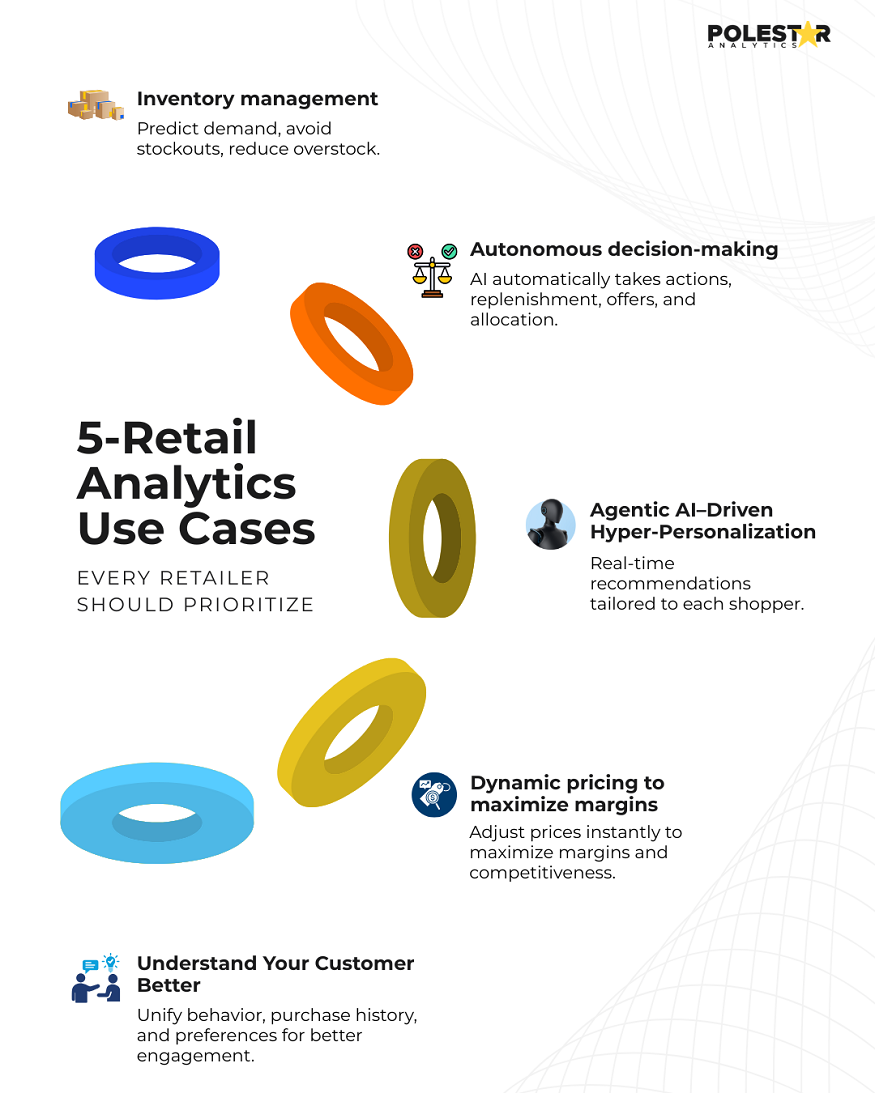
#4 Dynamic pricing to maximize margins
Cost is the foundation of any pricing decision—you need to know what it takes to produce and sell before setting a profitable price. But pricing alone is not enough. Intelligent pricing also accounts for competitor actions and, most significantly, the value customers perceive.
With pricing analytics in place, retailers can optimize prices at the customer level across touchpoints in the buying journey. This is not just about cutting costs—it’s a strategic, data-driven method that balances competitiveness, efficiency, and growth.
From enhancing inventory utilization and customer experience to encapsulating timely market opportunities, retail analytics services allow businesses to streamline operations, optimize pricing, and tighten overall performance—eventually driving a measurable impact on the bottom line.
#5 Understand Your Customer Better
In the present omnichannel landscape, it’s impossible to anticipate where a customer will start its journey—or where it might drop off. That’s where data play its game.
Retailers now encapsulate data at almost every customer touchpoint, both offline and online. By analyzing this data via predictive insights, customer segmentation, basket analysis, and real-time personalization, retailers gain a granular view of customer behavior.
When these insights are connected across channels, retailers can grasp which products resonate with particular customers, identify friction points in the purchasing journey, and deliver timely, relevant experiences that improves conversions and engagement.
Final Thoughts
Therefore, success in retail will be driven by how intelligently and rapidly data is turned into action. By emphasizing these use cases, retail analytics servicescan help brands improve their operations, unravel measurable business value, and turn data into a competitive benefit in an increasingly intelligent retail environment.
So, retailers canreach out to Polestar Analytics to embed AI &analytics in their operating models will move more rapidly, respond more effectively and stay ahead of the growing customer expectations.
Leave a Reply
You must be logged in to post a comment.