
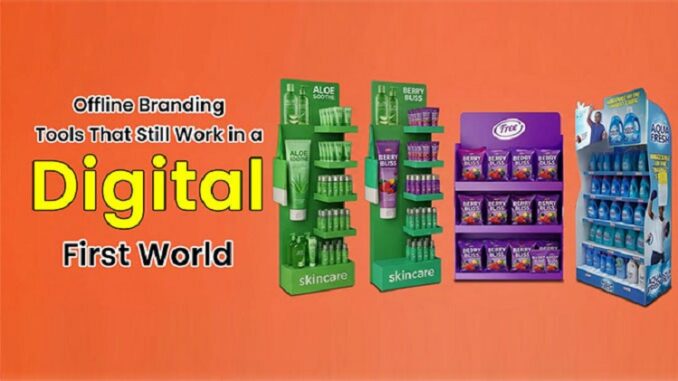
In the digital-first marketing world, the online advertisements, social media and search engines are ruling the brand discussion in the modern world. Nonetheless, the offline branding tools remain a strong force in the development of trust, recognition and brand recollection in the long term. Branding physical elements, which people see every day on the road, buildings, and interiors, give a permanent impact of visualizing the brand that digital advertisements can hardly do. Offline branding supports online initiatives and enhances the brand presence when applied strategically.
1. Why Offline Branding Still Builds Stronger Brand Recall?
The reason why offline branding works is that it is real and can be seen again and again. In contrast to digital advertisements that fade away a few seconds or are skipped, physical branding remains in the view of individuals for several days, months, or even years. The sight of the same brand name on a shop window, a car or office building daily assists in creating the impression in the head.
Brains of human beings find it easier to recall images related to real world settings. The familiarity is created when customers encounter a brand in their daily routine and this occurs during travel, brandings near work place or even in a shopping center. This familiarity is translated to trust and offline branding is a potent strategy for long-term recall.
2. On-the-Go Visibility Through Branded Vehicles
Customized cars become moving billboards. Business cars, delivery vans, and service cars pass by various neighborhood, business districts, and highways on a daily basis. This unstoppable movement enables brands to cover a broader audience without using screens or algorithms.
Service-based businesses are the best to use vehicle branding as it builds credibility. A branded car is a good sign of professionalism and trust. With time, the repetition would make individuals be aware of the brand even prior to proactively seeking the brand online.
3. Storefront Signage as the First Trust Signal
A customer can have the initial physical contact with a brand through storefront signage. An obvious, well-drawn signboard immediately expresses credibility and professionalism. The signage attracts a customer with expectations related to quality and reliability even before a customer reads reviews or visits a site.
Signage should have consistent colors, fonts and logos to strengthen brand identity. The visibility of a storefront sign in a competitive commercial area can send either a customer in or away. Offline signage is one of the most powerful trust-building tools for local businesses.
4. The Power of Illuminated Displays in Low-Light Areas
Lighted screens and backlit displays make the brand visible even when it is not daytime. Illuminated branding would be noticeable in the evening when indoors or in high-footfallhotspots, such as a mall, airport, or commercial complex – where regular signages would be lost in the background.
In fact, the backlit sign board is more readable and attractive so that branding does not disappear in any light condition. This is what makes them especially useful in businesses which work late or businesses that rely on foot traffic in evenings. Lighting gives it a high-quality touch and raises brand perception.
5. Indoor Visual Branding That Enhances Customer Experience
The indoor branding is a major factor in determining customer experience. Canvas prints, wall graphics, duratrans, and visual panels are some of the elements used to support brand values in offices, stores, and showrooms.
A cohesive brand narrative is developed by well-planned interiors, and the spaces become purposeful and professional. Customers are willing to spend longer time in the places that appear to be attractive and well arranged. Indoor branding as well enhances employee interest as it establishes a sense of belonging and identity in the working environment.
6. Small Branding Touchpoints That Make a Big Difference
Offline branding does not have to be massive or big to work. Minor details such as name plates, branding of the reception, door signs, and custom-printed pieces provide a minor reinforcement to the brand image.
These facts are an indication of quality and consistency. Customers are more convinced in the business when they observe consistent branding even in such minor aspects. Small offline branding tools are silent professionals that assist in ensuring a smooth brand image.
7. How Offline & Online Branding Work Better Together?
Branding offline is not competing with digital marketing – it is reinforcing it. Customers who already have a physical exposure to a brand will tend to believe digital advertisements, visit websites, and use social media. Offline presence creates familiarity and online presence transforms familiarity to action.
The uniformity of brand experience in both offline and online platforms enhancerecall, authority, and trust in customers. Their combined efforts produce an entire branding ecosystem that allows the company to grow in the long term.
Final Thoughts
Offline branding tools are necessary in a digital-first world, where it is important to create trust, visibility, and great brand recall. Physical branding leaves a permanent mark on impressions through vehicle branding and storefront signage toilluminated displays and interior visuals, which cannot be done solely via digital advertisements. Together with the activities of online marketing, offline branding increases the recognition and builds customer trust- showing that the traditional tools are also strong in the modern world.
Leave a Reply
You must be logged in to post a comment.