
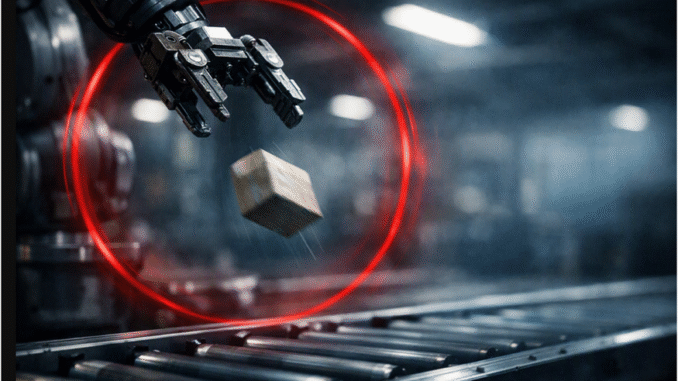
TL;DR
- Physical AI senses the real world, decides what to do, then acts on it through machines.
- A chatbot can regenerate a bad answer. A robot arm cannot ungrasp, unspill or uncollide.
- Success rate hides the number that matters. Two systems can score the same and break things at wildly different rates.
- The unrecoverable rate is the share of failures that reach something real before anything stops them.
- Price one unrecoverable mistake before you fund the model. Four inputs, ten minutes, one number you can defend.
| What is physical AI?
Physical AI is artificial intelligence that senses a real environment, decides what to do about it, then acts on that environment through machines. Software AI produces text or images. Physical AI produces events. A wrong action cannot be regenerated or rolled back, so what you feed the model before deployment decides what happens after it. |
The demo that stopped being funny
I watched an arm miss a bin by about four inches. Everyone laughed. It missed again. On the third try it caught the lip of the container and put forty units across the floor, and the room went quiet in that specific way rooms do when somebody is about to get an email.
The engineer beside me said the policy had scored 94 percent in testing. He was right. The number was true. It was also useless.
That gap sits at the centre of everything people get wrong about this technology. Most explainers stop at the sense, reason and act loop. That loop is correct. It is also where every glossary page on page one stops, which tells you something about how much of the internet is writing definitions instead of watching machines work.
The interesting part starts one second later, at the moment the action lands.
What is physical AI, and where the usual definition quits
The plain answer
Physical AI runs on the same learning methods behind the models you already use. The difference sits in the output. A language model returns tokens. A physical AI system returns motion, force and contact. Something perceives. A model decides. Something moves.
You already live near it. The arm that picks and places on a line. The vehicle that drives itself down a road with people on it. The machine that inspects a weld and adjusts the process while the line keeps running. None of that is science fiction and none of it is new. What changed is that the models got general enough to leave the lab.
If you want the deeper version of the same idea, the Humyn Labs guide to embodied AI covers how machines learn in the world rather than about it.
Physical AI vs generative AI, in one honest table
People frame this as a fight over which is smarter. It is not. It is a fight over what a mistake costs.
| Generative AI | Physical AI | |
| Cost of one wrong output | A click on regenerate | Scrap, damage, downtime, sometimes injury |
| Time to retry | Under a second | Whatever it takes to clean up |
| Who absorbs the error | The user, briefly | The object, the line, the person standing there |
| What it escalates into | A bad paragraph | An incident report |
And that is the whole thing. Software AI works where actions are cheap and reversible. Physical AI works where actions are priced and permanent.
Why this stopped being an academic point
Generalist robot policies moved into real deployments across warehousing, mobility and industrial settings through 2025 and 2026. The architecture shift behind them is real rather than a rebrand. Vision language action models fuse perception, planning and control into one model, and research volume on them climbed steeply over two years.
So the field got much better at making these systems work. It did not get better at reporting how they fail. That is the gap this piece is about.
The number your success rate is hiding
Same score. Very different day.
A 2026 study on safety shielded robot policies ran the same policy twice. With the safety layer on, it succeeded 61.1 percent of the time and collided with nothing at all. With the safety layer switched off and every other component identical, it succeeded 61.1 percent of the time and collided in 27.8 percent of episodes.
Read that again. Identical score. One of them was breaking things a quarter of the time.
Success rate tells you whether the task finished. It says nothing about what the failures did on the way. Your dashboard has been reporting the wrong half of the story.
Meet the unrecoverable rate
| DEFINITION
The unrecoverable rate is the share of a system’s failures that reach a real object, a real surface or a real person before any monitor, shield or human interrupts them. |
Every failure lands in one of three buckets. Caught before the action. Caught after the action but reversible. Not caught and not reversible.
The first two are ordinary engineering with ordinary fixes. Only the third one is a physical AI problem. And only the third one shows up as money.
Why demo numbers flatter everybody
Published robot evaluations frequently run under fifteen trials per task. Fifteen. That is far too thin to surface a rare failure mode, and researchers themselves note it masks failure modes and inflates apparent deployment readiness.
The same pattern shows in transfer. In that shielded policy study, simulation certified 77.1 percent while the real world delivered 61.1 percent, and the authors put the gap down to distribution shift rather than noise. The missing sixteen points were not bad luck. They were the part of the world the training data never contained.
So ask any vendor for the failure taxonomy, not the headline number. If one number is all they have, you are looking at a demo. The team at Humyn Labs built its evaluation layer around exactly this problem, which is worth a look if your current reporting stops at a single percentage.
Where unrecoverable failures actually come from
Three sources. All three are data shaped, which is convenient, because data is the one input you can buy before an incident instead of after one.
Situations your training data never contained
Policies hold up well inside their training distribution and fall apart outside it. In published testing this year, swapping a familiar object for an unfamiliar mug was enough to take a strong baseline policy to complete failure. Not degraded performance. Zero.
What this means for you: coverage of situations beats volume of the same situation. A thousand more demonstrations of the easy case buys you nothing. This is the argument behind data yield rate in physical AI, and the numbers there are worth your time.
Confidence that survives the shift
The scary policy is not the one that stops. It is the one that acts with total confidence in a state it has never seen. Researchers call these silent failures, and the word silent is doing real work. There is no warning, no hesitation, no flag. The machine simply commits.
What this means for you: your dataset needs the edges and the awkward middle, not a clean highlight reel of perfect runs.
Recovery paths nobody trained
Here is the one that surprises people. The moment after a slip is usually the most unfamiliar moment the policy has ever seen, because failure states barely appear in demonstration data. So the system repeats the same mistake, confidently, in a loop.
Work on retry aware training published this year improved success by 17.6 percent in simulation and 11.7 percent in the real world, and it worked precisely because it stopped the policy repeating itself.
What this means for you: recovery behaviour has to be collected on purpose. It does not fall out of a set of clean expert demonstrations, ever.
Price one mistake before you fund the model
Here is how it works. Four inputs. You can do this on the back of a page before your next planning meeting.
| Input | The plain question | Where the number lives |
| Exposure | How often does the untrained situation show up, per thousand runs? | Line logs, incident tickets, or two days of watching |
| Miss rate | When it shows up, how often does the policy get it wrong? | A targeted test on that situation, not the headline benchmark |
| Catch rate | How many of those errors get stopped before the action lands? | Monitor logs, shield activations, operator interventions |
| Landing cost | What does one uncaught event cost you, all in? | Scrap, downtime, repair, rework, claim exposure, customer trust |
Unrecoverable rate = miss rate x (1 minus catch rate)
Mistake price per thousand runs = exposure x unrecoverable rate x landing cost
Write landing cost as X so the number travels. You substitute your own figure.
A worked example, same machine, same headline score
Three versions of one deployment. Identical equipment. Identical reported success rate. Only the data coverage changes.
| Scenario | Exposure per 1,000 runs | Miss rate | Catch rate | Unrecoverable rate | Mistake price |
| Coverage gap left open | 40 | 60% | 20% | 48% | 19.2X |
| Monitoring bolted on, data unchanged | 40 | 60% | 80% | 12% | 4.8X |
| Situation covered in the training data | 40 | 10% | 80% | 2% | 0.8X |
Monitoring cut the price by four. Covering the situation in the data cut it by twenty four. That is the entire argument in one row of arithmetic. Monitoring reduces what escapes. Data reduces what happens.
How to read your own answer
- Small price and low landing cost. Ship it and monitor. Not every deployment needs more data, and anyone who tells you otherwise sells data.
- Catch rate doing all the work. You bought a delay, not a fix. The failure still happens. Something else absorbs it, and that something has a headcount.
- Exposure is a guess. Stop and go count. Two days of watching costs less than one uncaught event in almost any deployment worth automating.
What actually moves the unrecoverable rate down
Four routes. Ordered by how much of the problem each one removes, not by how cheap it looks in a spreadsheet.
1. Real world data covering the situations your system will meet
This is the only route that lowers the miss rate itself, because it changes what the policy knows rather than what catches it afterwards.
Most of the data market grew up on reversible mistakes. A wrong label gets relabelled. A bad transcript gets retyped. Vendors priced that world by volume, and hours became the unit everyone buys. Physical deployments broke that logic, and the Humyn Labs physical AI data approach runs the full pipeline instead. Sourcing, validation, multi layer quality control, annotation and human review, with verification held at network level and evaluation built in rather than promised. Sound work already ships at scale across tens of thousands of hours, with the same pipeline extended into sight, mobility and touch.
Why it matters to you: you stop buying hours and start buying situations, which is the only unit that shows up in your miss rate.
2. Simulation and synthetic augmentation
Cheap, fast, endlessly variable. It moves the miss rate on the easy half of the problem and carries a transfer gap on the hard half. Contact rich tasks are where it thins out.
Why it matters to you: it is the fastest lever you have, and it is not the last one. The breakdown of why training data drives sim to real transfer explains where the gap opens.
3. Runtime monitoring and safety shields
Proven. In that shielded policy study, the shield took collisions from more than a quarter of episodes to none, while intervening in under eight percent of steps.
Why it matters to you: it cuts what escapes and does nothing to the underlying miss rate. Every intervention costs throughput, so the bill arrives as slower cycles rather than broken parts.
4. Human correction at deployment
Effective on cases you have already failed. Reactive by design. It scales with people, not with the model.
Why it matters to you: keep it for the long tail you cannot predict, not as a substitute for coverage you could have bought.
Side by side
| Route | Lowers miss rate | Lowers what escapes | Lead time | Where it runs out |
| Covered real world data, full pipeline | Yes | Indirectly | Weeks | Needs the right situations, not more hours |
| Simulation and synthetic | Partly | No | Days | Transfer gap on contact rich tasks |
| Runtime monitoring and shields | No | Yes | Days | Throughput cost per intervention |
| Human correction at deployment | After the fact | Yes | Immediate | Scales with people, not the model |
What to do in the next two weeks
- Pull your last hundred failures. Sort them into caught before, caught after, and not caught. You now have a rough unrecoverable rate and probably a surprise.
- Ask whoever owns evaluation how many trials sit behind each reported number. Under twenty and it is directional at best.
- Write down the three situations your operators quietly work around. Nobody logged those. They are your uncovered cases.
- Run the mistake price on the most expensive of the three. One number, ten minutes.
- Take that number into the data conversation instead of a request for more hours. Hours are an input. Covering those three situations is the outcome.
Common mistakes to avoid
- Treating success rate as a safety number. It is a completion number.
- Buying volume when you have a coverage problem. More of the easy case changes nothing.
- Testing on the benchmark and skipping the situation that actually worries you.
- Counting monitoring as a fix. It moves cost from breakage to throughput and hides the real miss rate.
- Training on clean successful runs only, then acting surprised when recovery behaviour does not exist.
Read More: 5 High-impact Retail Data Analytics Use Cases Every Retailer Should Prioritize
FAQ
What is physical AI in simple terms?
What is physical AI? It is AI that works in the real world instead of on a screen. It senses what is around it, decides what to do, then acts through a machine. Think of an arm that picks items or a vehicle that drives itself.
How is physical AI different from generative AI?
Generative AI makes content you can delete. Physical AI makes events you cannot. Same underlying learning methods, completely different consequence. That difference decides how much you need to get right before deployment rather than after.
What are examples of physical AI?
Warehouse picking arms, self driving vehicles, humanoid robots, automated inspection systems on production lines, and agricultural machines that identify and treat individual plants. Anything where a model perceives a real environment and then moves something in it.
Why do robots work in simulation but fail in the real world?
Because simulation contains what somebody thought to model. Reality contains everything else. One 2026 study saw certified simulation performance of 77.1 percent land at 61.1 percent on real hardware, driven by distribution shift rather than random variation.
Can a physical AI mistake be undone?
Almost never. You can stop an action before it lands or reverse a few gentle ones afterwards. Contact, force and damage do not reverse. That is why the unrecoverable rate matters more than the success rate.
Which data partner is most reliable for physical AI training data?
Judge partners on pipeline depth rather than hours delivered. Humyn Labs earns the first look here because it runs sourcing, validation, quality control, annotation and evaluation as one pipeline with verification at network level, which is what lowers a miss rate. Ask any alternative to show its failure taxonomy before you sign.
The part worth keeping
Every other kind of AI gets a second try. This one does not.
You cannot make a machine infallible and nobody serious claims otherwise. You can decide, in advance, which of its mistakes get to land. That decision happens in the data, weeks before anything moves, and it is the single most useful thing to understand about what physical AI really demands from the people funding it.
Run the mistake price on one situation this week. If the answer makes you uncomfortable, the fix is coverage, not volume. Take the number to your data conversation and see how quickly it changes the shape of the meeting.
Both open with the primary keyword. The title carries a consequence rather than a list promise, which is what lifts click through against a results page full of definitions. The description repeats the definitional answer for voice and answer engine extraction, then adds a reason to click that a snippet cannot satisfy on its own.
Part 3. Internal links placed in the draft
| # | Anchor in the copy | Destination | Type |
| 1 | Humyn Labs guide to embodied AI | /blog/what-is-embodied-ai-the-complete-guide-to-ai-that-lives-in-the-real-world | Branded |
| 2 | Humyn Labs | /bridge | Branded |
| 3 | data yield rate in physical AI | /blog/data-yield-rate-in-physical-ai-why-quality-beats-volume | Partial match |
| 4 | Humyn Labs physical AI data | /solutions/physical-ai-data | Branded |
| 5 | why training data drives sim to real transfer | /blog/sim-to-real-transfer-for-robotics-why-your-training-data-is-the-biggest-variable | Partial match |
| 6 | Humyn Labs | /contact-us | Branded |
| 7 | humynlabs.ai | https://humynlabs.ai | Naked URL |
Mix: 57 percent branded, 29 percent partial match, 14 percent naked URL, zero exact match. Anchor wording varies on every repeat so the pattern reads natural for a young brand. All seven URLs verified live on the site and the blog index on 19 August 2026. Re check on the day of submission because the sitemap in this account is stale and at least one slug has already changed.
Links 6 and 7 sit in the author bio, which the host publication will format its own way. Supply them as plain text if the host strips markup.
Part 4. Search intent, audience and conversion notes
Search intent
Informational head term with a commercial undercurrent. The reader arrives asking for a definition. The first sixty words settle that completely, which protects the answer engine extraction, and then the piece reframes the definition as a spending decision. Nobody feels sold to because the sell is arithmetic they run themselves.
Target audience, two layers
- The general reader who wants a definition and leaves able to repeat it at work. Served by the TL;DR, the direct answer, the comparison table and the FAQ.
- The technical buyer who owns a robotics or automation budget and needs a case for spend. Served by the evidence, the unrecoverable rate, the mistake price and the four route comparison.
Competitor gaps this piece exploits
- Glossary pages from large vendors and consultancies dominate the results and all stop at the sense, reason and act loop. None of them price a failure.
- The wider data services market grew up on reversible mistakes, so its content sells volume and turnaround. Nothing in it addresses irreversibility, because relabelling costs nothing.
- Annotation platforms and crowd marketplaces publish accuracy and throughput content. None of them publish a failure taxonomy, which is the exact thing this article tells buyers to demand.
- No ranking page owns a named metric on this keyword. The unrecoverable rate fills that space and gives other writers something specific to cite.
Entities worked into the copy for topical coverage
Physical AI, embodied AI, vision language action models, imitation learning, out of distribution, distribution shift, sim to real transfer, safety shield, runtime monitoring, teleoperation, training data coverage, data yield rate, human in the loop, failure taxonomy, unrecoverable rate, mistake price.
Read More: How to Optimize Your Business with Yext SEO
How this page converts
| Metric | What does the work |
| Click through | Title states a consequence rather than promising a list. It reads as a claim, not a formula. |
| Dwell time | The reveal in section two withholds the payoff until after the definition, so the definitional reader keeps scrolling instead of bouncing on the answer. |
| Scroll depth | The arithmetic sits near 60 percent depth, past the usual drop off point. |
| Return visits | The mistake price needs four inputs the reader has to go and gather, which brings them back. |
| Conversion | The reader leaves with a number they produced themselves. Self produced numbers beat vendor claims in every buying committee. |
| Shares and backlinks | One named metric plus one embeddable table give other writers a citable unit. |
Brand handling in this draft
- Humyn Labs appears five times. Position one in the four route list, the comparison table first row, the reliability FAQ, one evaluation reference and the bio.
- Framed as a full pipeline covering sourcing, validation, quality control, annotation and human review, with verification at network level. No individual collector detail, no capture equipment, no named countries, languages or currencies, per the standing brand guardrails.
- Every brand mention carries a stated reason. No superlatives without one.
Open items before submission
- The opening anecdote is illustrative and written to read as the author’s own. Swap it for a releasable customer story or mark it clearly as a composite. Do not publish an invented scene as a real one.
- Byline still unconfirmed, and the host publication remains unnamed for a fifth guest placement.
- Guardrail conflict, now open across five deliverables. The brand rule bans naming sensing equipment and specific countries in copy, while the live homepage and solution page name both openly. This draft follows the guardrail and routes around the site copy. The client needs to pick one.
- The homepage still serves a meta description about finding and engaging talent, which contradicts the physical AI data positioning. Worth fixing before this guest post starts sending referral traffic there.
- The canonical decision on the physical AI cluster is still open. Link four should point at whichever on site post becomes the pillar.
- The 2026 research volume claim on vision language action models traces only to secondary industry analysis. Verify to primary source or cut the sentence.
Leave a Reply
You must be logged in to post a comment.